Or Kazimir Malevich’s White on White, which was "enriched" by the Russian performance artist Alexander Brener in 1997 with a neon-green dollar sign. There were people in the museum. But again: no photo of the actual act. Just the result. Just Brener later, fists raised, flanked by security, proudly marching away from the scene.
I recently started to write prompts to generate images of these moments with AI. Not as a form of glorification, but out of curiosity: What could these moments have looked like? If you could freeze the precise second someone takes a knife to Barnett Newman’s massive field of red, or throws a rock at the Mona Lisa, what would you see?
To my surprise, the generated images–with support of ChatGPT–weren’t “shocking” in the way I expected. What surprised me instead was how cinematic, how theatrical they felt. The expressions. The body language. The stunned bystanders just starting to process what they’re witnessing; it's probably partly due to how I described the prompt, but the AI probably also "knows" context about the situations I described. Eventually these aren’t just recreations; they’re visual dramatizations. Moments suspended in uncanny stillness, full of tension.
Without actual photos, we’re left with either eyewitness descriptions or post-facto images of slashed canvases behind glass. My attempt to fill that gap—albeit digitally, theatrically, speculatively—opened a new kind of window: not into what really happened, but what we might see if we had been standing there, our phone miraculously ready, before history settled into memory.
I hope to see a future filled with AI-generated digital tableaux vivants—reimagined scenes of breaking news or historically significant moments—that help visualize undocumented stories. Just as paintings once captured decisive episodes long before the camera existed, these modern dramatizations could offer a new kind of visual storytelling: evocative, speculative, and theatrical, yet grounded in real events.

 ]]>
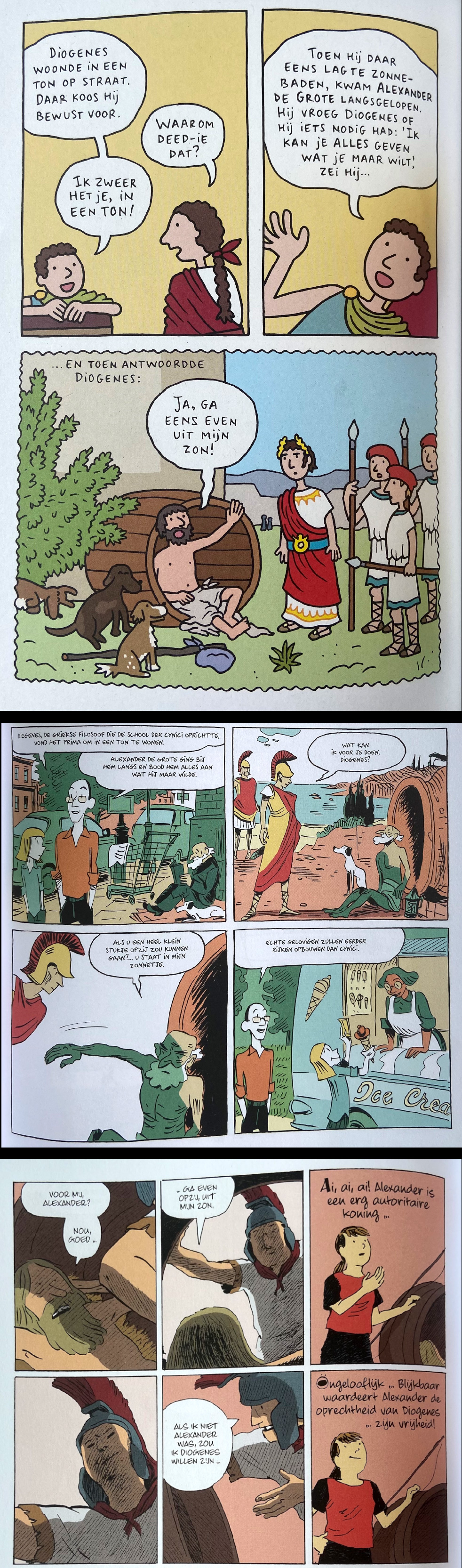
]]>Since the book Logicomix by Apostolos Doxiadis and Christos Papadimitriou was published in 2009, I grew an interest in history and philosophy based graphic novels. Over the years I bought several of them and recently I read Sophie's World, based on Jostein Gaarder's children's book on the history of Western Philosophy. I was sure I had seen images in it about the above ancient story. And since the book is set up chronologically, I knew I would be able to find it somewhere in the beginning. And yes! Sophie has a conversation with Diogenes, while he's walking his fish on a leash, and on return to his jar he lays down to take a rest. Then in comes Alexander the Great and asks his question.
The nice thing about the visual interpretation in this book is that the drawer takes quite some images to tell the story. Furthermore, there's one image which does not contain a speech balloon but just shows Alexander the Great in a bit confused and thinking state, and the reader feels the tension: how will Alexander respond to this very direct and not so polite wish from Diogenes. Even though knowing The Anecdote, that still moment of tension has great effect in the flow of images. I really like it.
But this wasn't all; I was conviced that I had seen it in another. At least, I had a clear sense that I must have seen it too in Harari's book Sapiens. And indeed, after some digging, one sees Harari having a stroll with his niece while he explains her the value of stories and beliefs, and tells her about the Greek school of cynicism that rejects basically all stories and beliefs, which the drawers support by depicting The Anecdote.
And contrary to Sophie's World, in which the perspective is more of a young adult being a bit frightened by the potential insult by Diogenes, Harari's use is supporting the argument in his textual lecture. The comic drawings support his talk, while in the former one experiences the situation at the jar.
In Barabara Stok's interpretation, the scene plays more the role of an eye opener to the main character Hipparchia – a female thinker with limited access to knowledge due to her cultural context. As she starts to reconsider her whole upbringing and social position after gaining interest in philosophical cynicism due to a servant telling her The Anecdote.
So apart from visual differences in line, color, depiction of texture and shadows, these three interpretations all support the main story in a different way. Over the past centuries many more artists have depicted The Anecdote and these three approaches are great additions to that collection. I can imagine there's more graphic novels out there that contain The Anecdote – I sure hope to find these sometime.
Images taken from:
- The Philosopher, the Dog and the Wedding: The Story of the Infamous Female Philosopher Hipparchia by Barbara Stok, 2022
- Sapiens: A Graphic History by Yuval Noah Harari, 2020
- Sophie’s World: A Graphic Novel About the History of Philosophy Vol I: From Socrates to Galileo by Vincent Zabus and Nicoby, 2022, based on Jostein Gaarder's book Sophie’s World
 ]]>
]]>Maar me praktisch voorbereiden moest ik natuurlijk ook. Zodoende kwam ik op het idee om als proef zelf tuinmeubilair te maken. Ik had ooit een boek gekocht met bouwtekeningen van meubilair van Gerrit Rietveld – ik kan me niet eens meer herinneren waar en wanneer, maar het moet zeker zo'n twintig jaar geleden zijn geweest. Ik had het wel eens doorgebladerd, maar ik had niet méér onthouden dan dat ik dat boek ergens in de kast had staan.
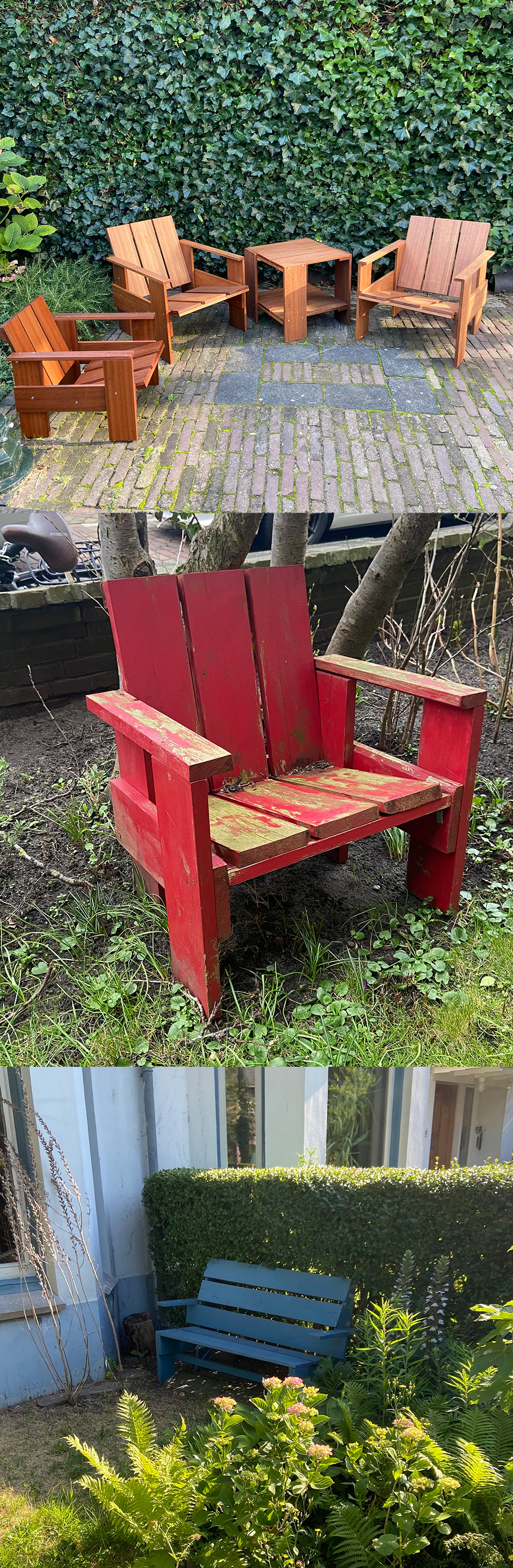
Dit leek me nou een goed startpunt: wanneer ik zelf de kratstoel uit het boek zou maken, voor elk gezinslid één, dan had ik twee vliegen in één klap: één ontwerp meerdere keren uitgevoeren, zodat ik per constructie lessen leerde die ik bij de bouw van de volgende kon gebruiken en het resultaat zou mooi design tuinmeubilair voor op het terras zijn.
Minutieus heb ik de bladzijden over de kratstoel gelezen en de tekeningen bestudeerd. In mijn hoofd had ik een 3D projectie gemaakt en alle maten kon ik dromen. Enkele aanpassingen waren noodzakelijk omdat ik het met standaard diktes wilde bouwen, die afwijken van wat in Rietvelds tijd gangbaar was. Ook wilde ik hardhout in plaats van vuren hout gebruiken om de levensduur van de stoelen te verlengen.
Omdat ik het boek meerdere keren doorgelezen had en ook nog overwogen had om Rietvelds tuinbank te maken, kreeg ik oog voor deze meubels. Zo vond ik de afgelopen maanden wandelend door Leiden, in het wild, in verschillende tuinen Rietveld meubels. De uitvoeringen varieerden, maar het waren allemaal onmiskenbaar Rietvelds ontwerpen.
 ]]>
]]>De eerste en ook de laatste keer, sinds vorig weekend, dat ik in Zaandam de Zaanse Schans bezocht, moet in 1991 of 1992 geweest zijn. Ik kan me de tingieterij nog herinneren, waar lepeltjes en borden gegoten werden. Het gestolde vliesje bovenop het vloeibare metaal staat me nog helder voor ogen. Behalve dat ik wéét dat er ook molens staan, heb ik er geen herinnering aan. Reden te meer om er weer eens te gaan kijken.
Na een stroopwafel en kaneelstokjes belandden zoon en ik in molen De Huisman waar we lichtelijk uit het lood geslagen werden door het zien staan van het boek De Schilders van de Zaan waar op het omslag wijlen schoonmoeder en oma Jola de Rijcke prijkt, natuurlijk geschilderd door eveneens wijlen Peter de Rijcke. Overrompeld door deze vondst, in combinatie met een vloed aan herinneringen, togen we geëmotioneerd verder en kwamen uit bij verfmolen De Kat.
Het was me geheel ontschoten maar in het verleden heb ik nog wel eens pigmenten via verfmolen De Kat besteld; al lange tijd runnen ze een informatieve website naast de molen. Omber werd er gemalen op het moment dat wij er waren, en na de molen technisch bestudeerd te hebben, bezochten we het kleine winkeltje. Niets dan fröbelspulletjes en lekkernijen, of wacht, ergens in een hoekje verkochten ze ook pigmenten. Natuurlijk, de echte doelgroep voor pigmenten weet de website van De Kat wel te vinden, toeristen nemen liever iets anders mee naar huis.
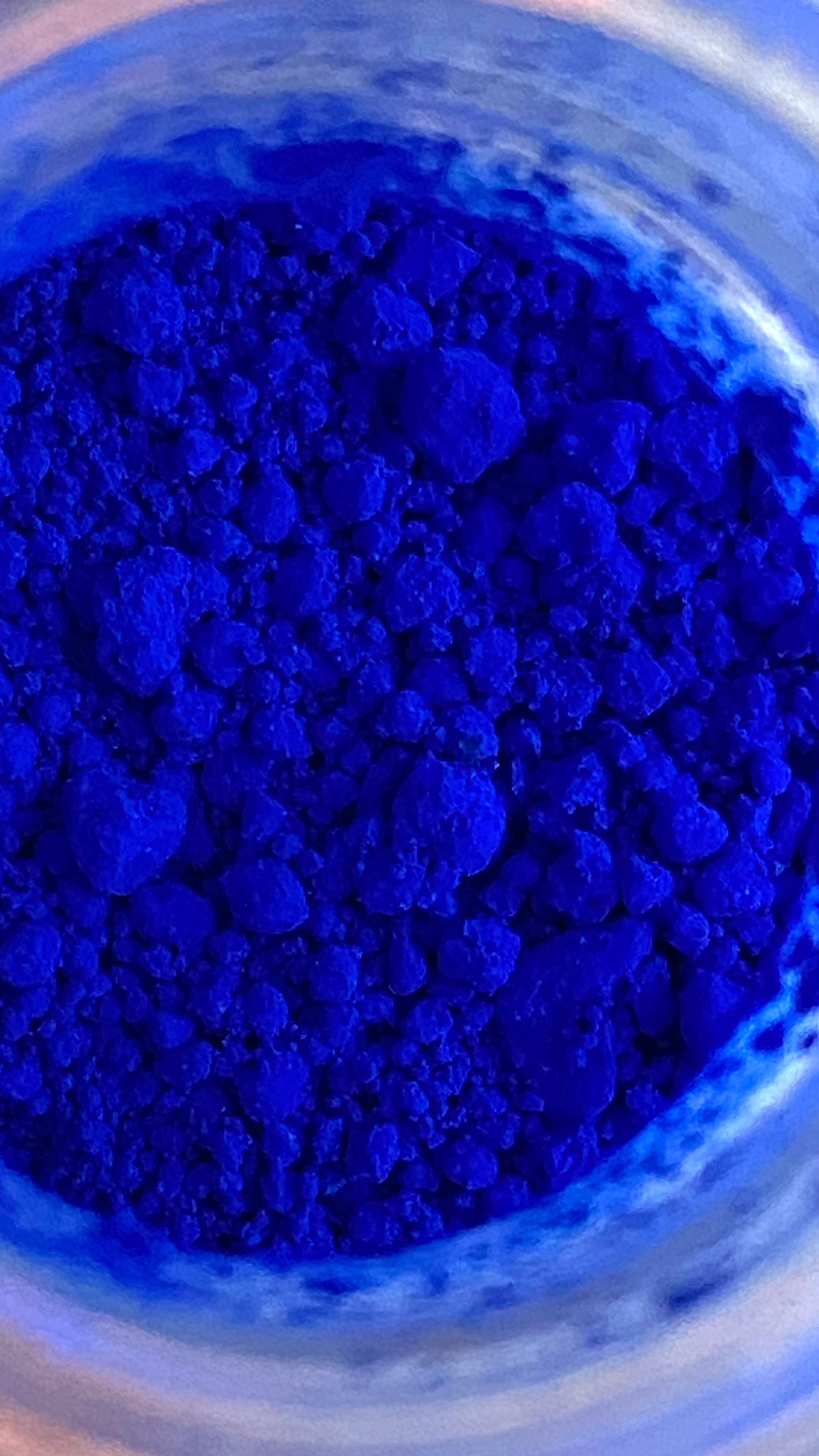
Ik kocht een potje "Ultramarijn blauw P.B.29"; mooi helder blauw. Het potje zelf is niet van super helder glas gemaakt, er lijkt een wittige waas in het glas te zitten. Je moet echt, zoals ik op mijn atelier pleegde te doen, de dop eraf draaien en het dan dicht bij één van je ogen houden. Fijne sensatie!
 ]]>
]]>Beide musea kenmerken zich door de ligging in de natuur. Beide hebben ook een zeer kenmerkende locatie binnen het gebouw waar architectuur, kunst en natuur samenkomen. In het museum in Otterlo is dat voornoemde hoek, waar grote glaspartijen ervoor zorgen dat je op gelijke voet met de natuur staat. In het Louisiana Museum bestaat een zaal met smalle hoge ramen die uitkijken op een door divers groen omzoomde vijver. Architectonisch zijn beide situaties goed uitgewerkte ideeën: de relatie die binnenruimte en buitenruimte aangaan is verbindend, daarmee het contrast benadrukkend tussen natuur en cultuur, maar de buitenruimte gaat ook een rol spelen in de binnenruimte.
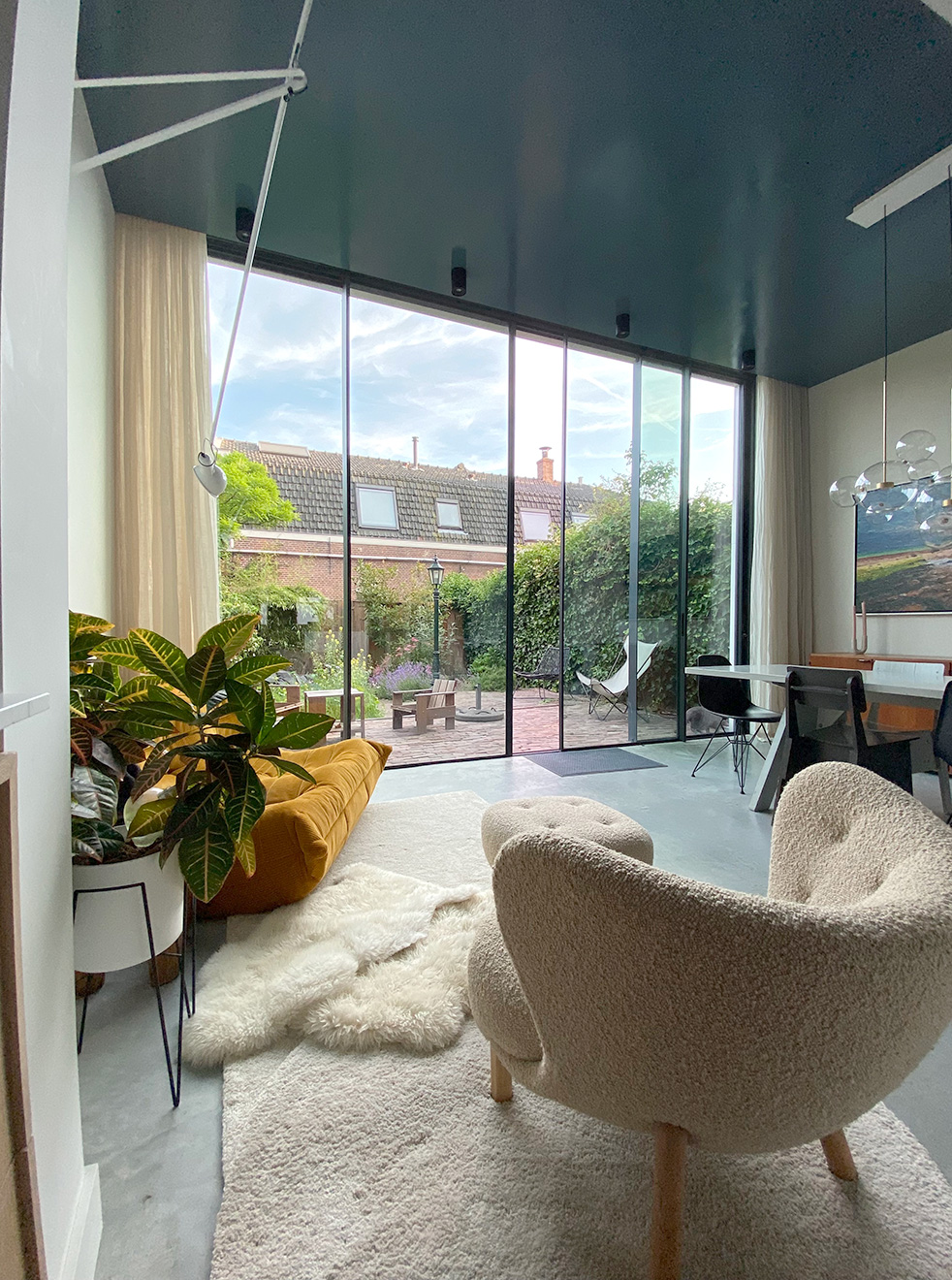
Toen wij ons huidige huis in 2017 betrokken hadden we al snel het plan om te verbouwen. Het kostte ons zeker vier jaar om tot een plan te komen, en na een architect in de arm genomen te hebben vorderde het ontwerp vlotter. Ik had in de opdracht meegegeven: we willen aan de achterzijde maximaal glas, om zoveel mogelijk licht te vangen, zodat we ook in de winter een licht huis hebben. De architect heeft dat vrij letterlijk genomen en tekende een raampartij van 5 meter breed en 3,40 meter hoog. Dat is ongeveer 17 vierkante meter glas verdeeld over vier grote ramen. "Het Grote Raam" noemen we het, naar Marcel Duchamps "The Large Glass" uit 1918.
 ]]>
]]>